Welcome!
 Welcome to Diploids Resurgent!
I'm Mike Huben, gardener, botanist, hybridizer, and all-around plant fanatic. (That's Magnolia ashei, a big leaf magnolia behind me.)
I've named my site "Diploids Resurgent" because I'd like to encourage others to appreciate the diploids too, rather than simply follow the tetraploid fashions. There's a world of daylilies out there besides southern-bred eyed and edged tets, and the most diverse are the diploids. Oh, I've got southern-bred tets in my garden: some are fantastic, and I wouldn't put them down. But here in the north (Arlington, MA -- near Boston) we have different needs that the southerners can't or don't breed for.
Every year I breed a thousand seedlings at my 1/5 acre. This small breeding program is carefully envisioned generations in advance, and focused on just a few goals.
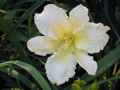
(1) Near-white rebloomers with qualities like Stella De Oro. Ever since I first saw the "Re" in a daylily description, I wanted rebloom in my garden. But even SDO balked at reblooming in my garden. It took 4 generations, thousands of seedlings, and 10 years, but I've succeeded. Improvements and diverse, clear colors are also on the way.
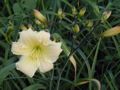
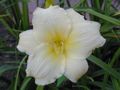
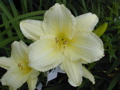
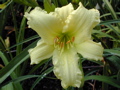
(2) Tall-and-small near-whites like Golden Chimes. I want that graceful, airy look to the tall scapes, clean white trumpets (or "butterfly" open flowers), and perhaps black scapes to contrast with the white flowers. I've now got 2nd and third generation seedlings, including a cream with dark scapes, very clear white trumpets, and 50 inch white trumpets.
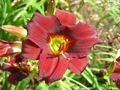
(3) Tall-and-small sunfast reds like Golden Chimes. My pet name for this project is "Fountain Of Blood". In my first generation, I have a 44 inch blood red with a green throat. It is perhaps the most sunfast red I've yet seen, and I've seen a lot of reds. Even more exciting is that it has long rhizomes like fulva. Perhaps I will breed something as persistant and spreading as fulva, which could be a "Niagra Of Blood".
I also allow myself a fair number of fun crosses to experiment with new ideas.
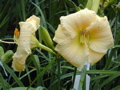
This year (2006) I won my first Honorable Mention award for Early And Often. It didn't win for its face: it won for performance. Let's hope that's a trend!
This site is an experiment with Blogger, to see how easy it is to make a small catalog with pictures. Let me know if you like it!

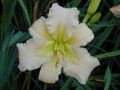
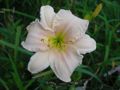
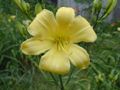
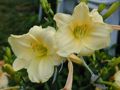
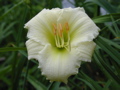
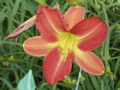
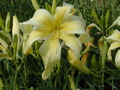
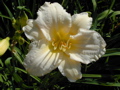


14 comments:
Nice website, Mike. Ice Trumpets is just beautiful! Congrats on the honorable mention for Early and Often. It was a champ in my garden, too.
Kathy P
hey i think all of this stuff is weird and i dont like it at all so yea thats wat i think
Love your website---easy to navigate! Enjoyed your presentation at the NEDS meeting very much. Have decided to try my hand at hybridizing diploids!
Adele K.
Wonderful website! Especially liked the way you linked Early and Often to a sampling of it's seedlings. I'm sold :)
Hi, Mike, I'm a gardener at the Smith College Botanic Garden in Northampton, Mass. We have put together a daylily display garden here, with all the Stout Medal winners and the species used in early breeding. I was sent a bonus plant from Hem Haven with a large order. It's called 'Fairhope Jubilee'. It's a diploid, repeats and has extended bloom. It is a double (not my favorite flower form) but I was really impressed last season - it was still blooming in November! Hope this might be helpful in your breeding pursuits,
Tracey
We found your website and pretty flowers! Hi Mr. Huben!
Hi, Tracey.
I looked up 'Fairhope Jubilee' and Hem Haven. I wouldn't expect it to normally rebloom here in the north (nor at Smith, which is nearby.) However, it is not uncommon for southern grown plants to rebloom the first year. The next year, they've usually subsided to smaller fans and single sets of scapes. If you observe differently, please let me know.
Mike, I didn't realize that southern plants had that propensity in the north, and I'll watch the plant this coming season (if, indeed, it *ever* comes). I'm writing an article for our Botanic Garden newsletter about how far we've come from the species to the hybrids of today. I've discussed the newer traits that are now selected for by some breeders, but would also like to discuss the breeding of rebloomers. I believe that scapes with many branches contribute to extended bloom, and using very early selections crossed with late blooming selections would contribute to possible 'continuous bloom,' especially combined with those plants that send up multiple scapes. I looked at your breeding plans page from 1999 and wonder why you would use nocturnal bloomers? Please disabuse me of any misinformation I have - I would like to make this article as accurate as possible. Thanks for your help!
Tracey
Magnificent plants.
I just ran across your website while checking out Bob Sobek's recent releases.
To get SDO-type rebloom in a variety of colors, and to get a Golden Chimes-type "wildflower" look in a variety of colors---and maybe eventually to combine the two---well, your breeding program is producing exactly the kind of garden plants that as a garden designer and plant maven I've always dreamed of.
Your plants clearly have the qualities that appeal not only to daylily collectors and breeders but to ordinary gardeners and landscapers as well. I hope in time they can reach a wider public.
Hi, Mike, looks like spring's finally on its way- Iris reticulata and crocuses are blooming here in Northampton. I LOVE 'A Small Multitude' - excellent! Also, that white seedling with the green throat (MH0447A) is fabulous. I also think your project to create downward-facing flowers is a great, novel idea. I also love martagons and some of the early hybrid lilies with pendant flowers. Good luck with that! The annual Botanic Garden bulb show starts this Saturday - stop in and get a real lift! By the way, some of the intro pictures on your site do not go to enlarge when clicked; maybe just a glitch. Have a great spring!
I became aware of your breeding objectives and progress during your presentation at the Ontario Daylily Society's 'CAN-AM Classic' a few years ago in Toronto. (For business reasons I had put my daylily interests on hold for several years and had only just recently returned to involvement in my gardens and daylilies at about the same time.)
Frankly, I was quite surprised (VERY pleasantly I might add) to find that there was someone else who liked the 'old styles of bloom', who liked 'small on tall', 'small on small/short' .... someone who wanted 'continuous bloom'and who worked with diploids with enthusiasm - and without 'apology'
Of course I was aware of Dr. Apps and his Woodside Nursery developments with diploids, his longer bloom season objectives, etc. And through your presentation I became aware of Bob Sobek's program, efforts,and achievements.
And now,other things too when you write on points such as your list of cultivars you would like to have and appraise for breeding, your own seedling critiques, observations of/at other diploid breeders, colour achievements, etc.
Such info contributes toward my own improving understanding of this great and complex plant - and diploids in particular.
All this to say that I do enjoy following your blog entries & updates & photos ... and that I use plants introduced from all three of you mentioned above in my own quest for improved bloom season length, 'Tall & Small' etc. here in southern Ontario.
Please keep those blog updates - especially with photos - coming as they are anticipated and well rec'd when published.
Thx. MGP (ODS/AHS member)
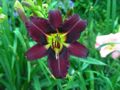
Mike, that seedling MH0735M looks fabulous. I love the dark stems with the flower color! Hope to see it offered someday, especially if the blooms are relatively small (kind of hard to tell in the photo).
Can't wait for spring - it was minus six this morning here in Western Mass.
Tracey
Hi Mike... your sister Em put me on to your site as she saw that I was goofing around with hybridizing daylilies and they are blooming for the first time this year. I'm afraid that I may have a taste for some gaudy lilies, but I'm still looking forward to following your site and maybe you can convert me! Actually I have a good friend with more taste than I, who has been trying for quite awhile! Larry
Like anyone cares?
Post a Comment